Stabilizing a Settling Home, Gilmanton, NH
Challenge
The owners of this beautiful home in Gilmanton, NH had been aware of settlement concerns for several years. As they prepared to make some renovations and improvements to the house, they realized the sinking foundation was causing larger problems, and understood they had to get it fixed before the problem could grow worse. When our specialist was on sight for a free inspection, he determined the following problems needing to be addressed.
- The foundation was settling at the rear of the building
- There was a large void beneath the garage slab
- The chimney on the side of the house was also susceptible to settlement
There were cracks in the foundation walls, as well as throughout the concrete garage slab at the back of the home. These cracks were clear signs that the sols beneath the structure had been shifting. Ultimately, the homeowners goal was to get their home's foundation permanently stabilized. The foundation had settled up to 2" in one corner, and was out of level 1" across the back. During the repair process, if lifting the settled foundation back to a level position would be possible, this would also be desired. Our specialist discussed the following recommendations and challenges with the homeowners;
- The landscaping and asphalt driveway would need to be removed in order to excavate around the foundation
- Push piers to be installed beneath the foundations footings
- Stabilization is guaranteed with piers, while lift is possible, though limited to site and soil conditions
- PolyLevel to fill voids beneath the garage slab
Solution
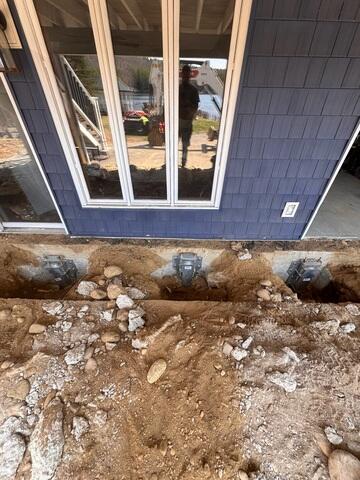
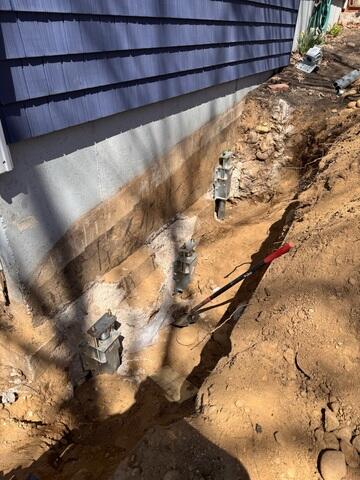
Our specialist proposed the installation of 12 Push Piers to address the foundation settlement concerns. The piers would be spaced 4' to 5' a part, with 6 of them beneath the foundation footing along the back wall, and 3 more on either side of the home to assist with stabilizing the corners. Two of these piers were also designed to be installed on either side of the chimney located at one of the house corners. Due to site conditions, some of these Push Piers were switched to helical piers on the day of installation. While helical piers have a slightly different installation method, the integrity and strength of the piers is comparable and guaranteed to provide the same results.
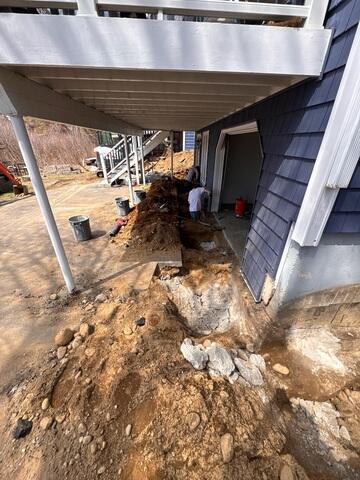
During the excavation process, our production team found the contractors that installed the foundation had an overpour situation. This means they had more concrete than they needed, and the extra material was just poured into the ground up against the structure. This extra weight, combined with loose soil conditions and poor compacting, ultimately led to the foundation sinking and settling over the years. In order to secure our piers to the foundation footing, our team had to chip away all this excess concrete and create a clean surface against the footings. While this was unexpected and added time to the project, it's an unforeseen obstruction which highlights the challenges of dealing with the unknown of soil conditions on any given project.
The piers were all successfully installed, and ranged in depth from 5' in some areas, to 10' in others. Each pier was tested for strength and weight load upon installation, and is guaranteed to not only stabilize, but provide some lift of the structure as well with a hydraulic pump system.
In total, the pier project took 5 days to complete. While it was recommended, the homeowners decided to hold off on the PolyLevel injection aspect to fill the voids beneath their concrete floor. This is something they may consider in the future. The work site area surrounding the home was backfilled with the existing material, and the homeowners are now able to continue with their renovation projects with peace of mind, knowing their home is permanently stabilized.
Project Summary
Installed Products: Push Piers, Helical Piers
Project Foreman: Nick Carelli