Foundation Wall Stabilization and Structural Reinforcement in Meredith, NH
Challenge
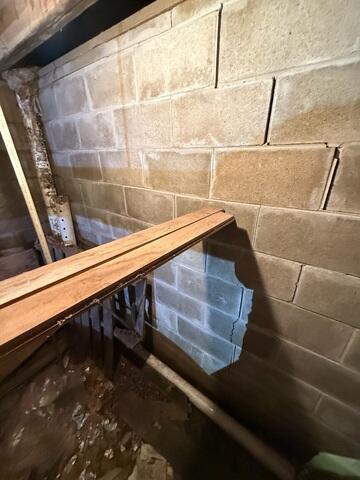
A homeowner in Meredith, NH contacted Erickson Foundation Solutions after discovering serious structural distress in a 40‑foot foundation wall. The wall had developed pronounced horizontal and stair‑step cracking following a crane parking incident adjacent to the home, indicating active inward movement and compromised load capacity. The homeowner’s primary concerns were safety, preventing further wall displacement, and restoring long‑term structural integrity to protect the home.
Our goal was to stabilize the failing foundation wall, redistribute lateral soil pressures, and permanently reinforce the structure—all while working around site limitations, including septic system placement that restricted full use of traditional exterior anchoring systems.
Comprehensive Evaluation & System Design
A System Design Specialist conducted a detailed on‑site inspection to assess crack patterns, wall displacement, soil pressures, and existing structural conditions. The evaluation confirmed that the wall was experiencing lateral loading beyond its capacity, with multiple failure points evident through horizontal cracking, stair‑step cracking in the masonry joints, and visible inward deflection.
Due to the proximity of the septic system, full‑length GeoLock® wall anchor installation was not feasible along the entire wall. As a result, a hybrid stabilization approach was designed to deliver maximum reinforcement while adapting to site constraints. The solution combined internal steel reinforcement, an auxiliary concrete wall, and strategically placed GeoLock® wall anchors wherever exterior access allowed.
Based on the site conditions and structural demands, we specified:
- 7 PowerBrace® steel I‑beam reinforcements
- 46 linear feet of StableLock® reinforced footing
- 40 linear feet of StableLock® auxiliary concrete wall
- 4 GeoLock® wall anchors
Together, these systems provided continuous stabilization, load transfer, and long‑term resistance to further movement.
Solution
PowerBrace® System: Internal Wall Stabilization
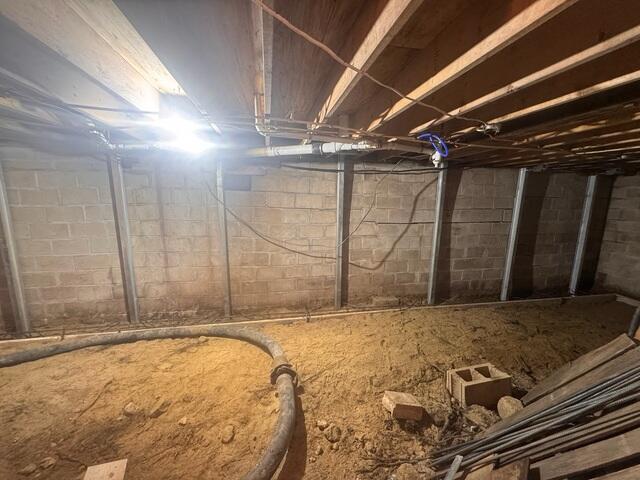
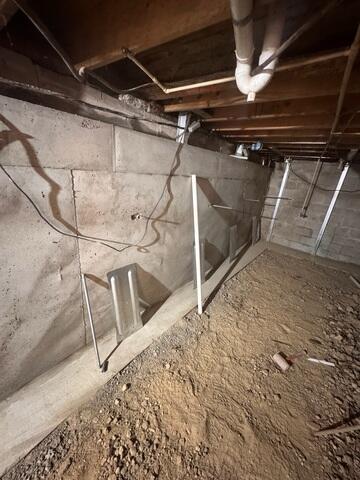
To immediately halt inward movement of the foundation wall, the PowerBrace® system was installed along the affected section. Each steel I‑beam was carefully positioned vertically against the failing wall and securely anchored to the floor system and overhead joists.
By tying directly into the home’s framing, the PowerBrace® beams created a permanent structural restraint capable of resisting ongoing lateral soil pressure. This system ensured the wall could no longer flex inward while serving as a critical load‑transfer component for the reinforced auxiliary wall to follow.
StableLock® Footing & Auxiliary Wall Construction
With the PowerBrace® beams in place, the next phase focused on constructing a reinforced auxiliary concrete wall to provide long‑term structural support.
Reinforced Footing Installation
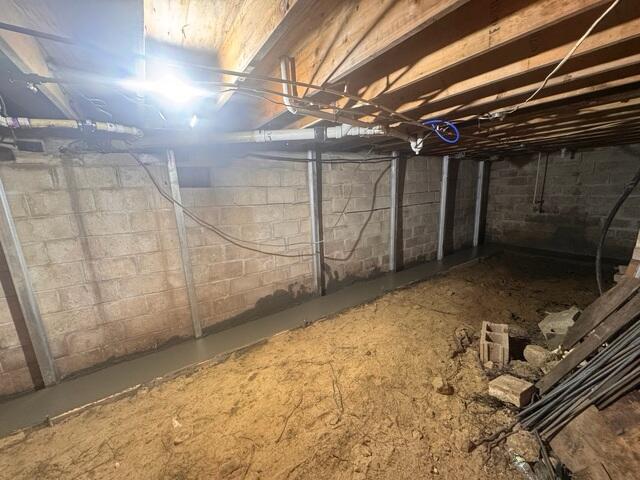
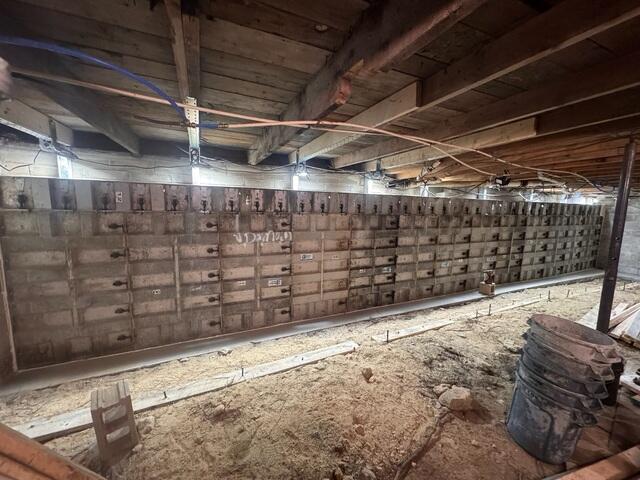
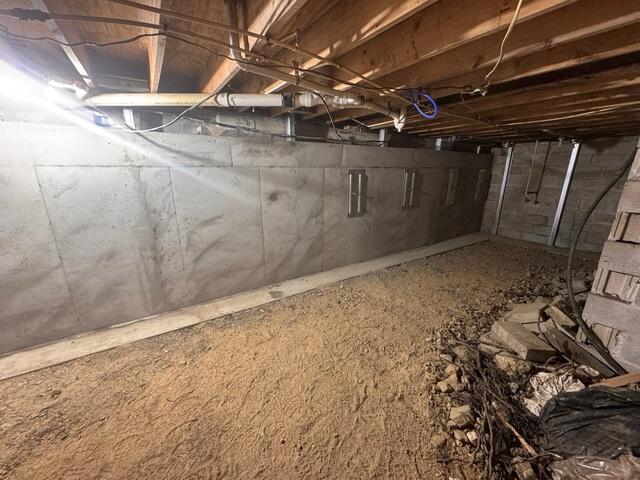
Concrete was poured to form a continuous reinforced footing along the interior of the foundation wall. This footing fully encapsulated the base of each PowerBrace® beam, locking them into position and significantly increasing their resistance to movement.
Rebar Integration
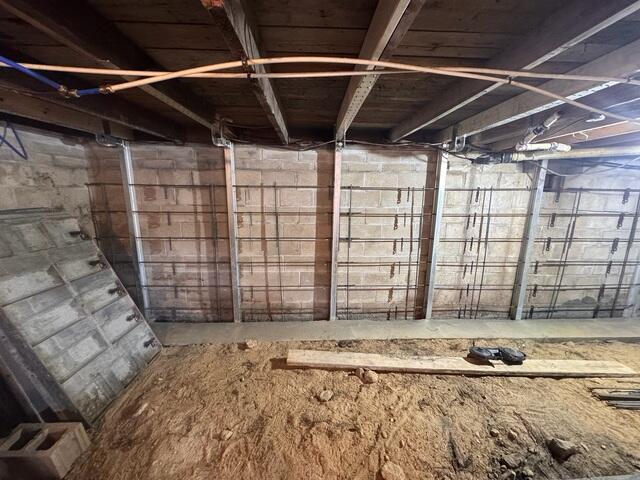
Reinforcing steel (rebar) was installed through the PowerBrace® beams and within the footing. This integration enhanced lateral load transfer and ensured that once the auxiliary wall was poured, the entire system would function as a unified structural element capable of resisting outward pressure.
Formwork, Bracing & Concrete Placement
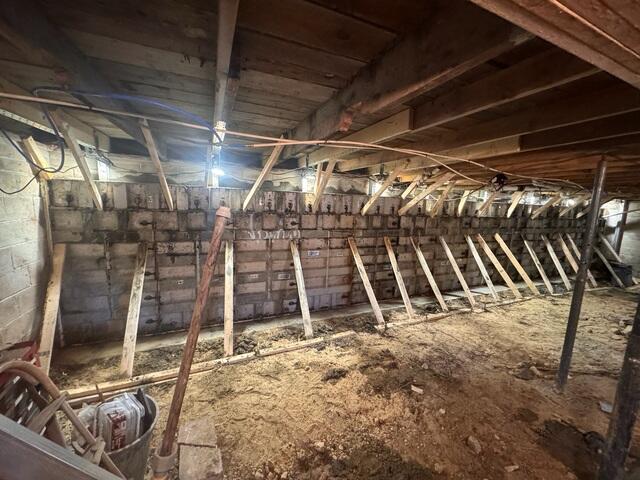
Formwork was constructed parallel to the existing foundation wall to define the dimensions of the StableLock® auxiliary wall. The forms were carefully aligned to ensure a straight, uniform wall profile.
To prevent deflection or failure during the concrete pour, the forms were reinforced with strategically placed wooden bracing. This bracing eliminated movement, maintained precise wall geometry, and protected against blowouts during placement.
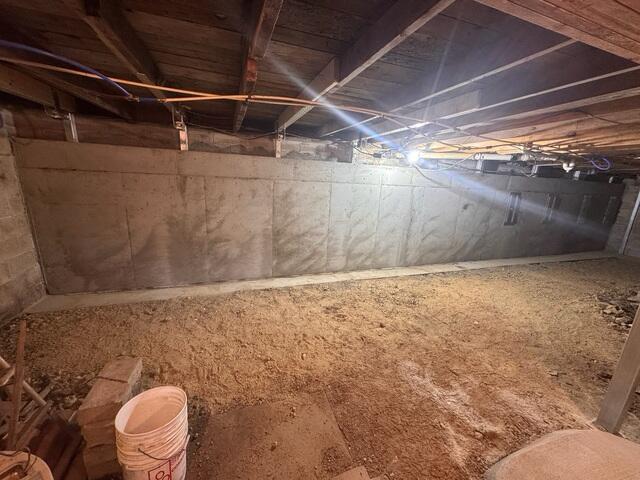
Concrete was then systematically poured between the existing foundation wall and the form system. Continuous vibration was applied throughout the pour to fully consolidate the concrete, eliminate air pockets, and ensure complete encapsulation of reinforcement elements. After the concrete cured to design strength, the forms were removed, revealing a solid, reinforced auxiliary wall that restored the structural integrity of the failing foundation section.
GeoLock® Wall Anchors: Supplemental Lateral Support
Where septic placement allowed, GeoLock® wall anchors were installed to provide additional lateral restraint against soil pressure.
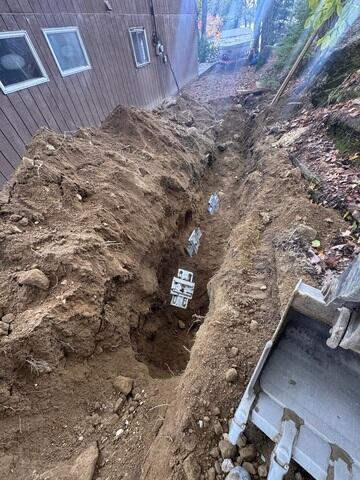
High‑strength steel GeoLock® rods were advanced through the new auxiliary wall and the existing foundation wall, extending into pre‑excavated exterior trenches. In stable, undisturbed soil, exterior anchor plates were attached and embedded to create a firm anchorage point.
Inside the basement, interior GeoLock® plates were positioned against the foundation wall and torqued to design specifications. Activating the system transferred lateral loads from the wall into stable soil, providing further resistance to inward movement and reinforcing the overall stabilization strategy.
Final Outcome
By combining PowerBrace®, StableLock®, and GeoLock® systems, the compromised foundation wall was fully stabilized and structurally reinforced. The transformation was immediate and dramatic—what began as a wall plagued by cracking and displacement is now a fortified structure designed to resist ongoing soil pressure and protect the home for decades to come.
The homeowner gained peace of mind knowing the foundation is secure, the risk of further movement has been eliminated, and the home’s structural integrity has been restored with a permanent, engineered solution.
Project Summary
System Design Specialist: Anthony B
Crew Foreman: Nick C
Systems Installed: PowerBrace, StableLock, GeoLocks